Uzbekistan holds the Silk Road’s greatest hits in one small, easy-to-cross country: the blue domes of Samarkand, the mud-brick old town of Bukhara, the walled museum-city of Khiva. But the places to visit in Uzbekistan do not stop at the famous three. This guide ranks the classic stops and the ones most tours skip, with the days each actually needs, so you can build a route that fits your time.
The places at a glance
| Place | Why go | Days |
|---|---|---|
| Samarkand | The Registan and Timur’s capital at full scale | 2 to 3 |
| Bukhara | The most atmospheric old town in Central Asia | 2 |
| Khiva | A walled city that feels frozen in 1800 | 1 to 2 |
| Tashkent | Soviet grandeur, bazaars and the famous metro | 1 to 2 |
| Shakhrisabz | Timur’s birthplace, an easy Samarkand day trip | Half day |
| Fergana Valley | Silk weaving, ceramics and traditional Uzbekistan | 2 |
| Nurata and Lake Aidarkul | A yurt night under desert stars | 1 |
| Nukus | The Savitsky Museum’s once-banned art | 1 |
| Moynaq | Ships resting on the dried Aral Sea bed | Day trip from Nukus |
| Termez | Buddhist ruins on the Afghan border | 1 to 2 |
| Chimgan Mountains | Skiing and hiking an hour from the capital | Day trip |
1. Samarkand: the Registan and Timur’s capital
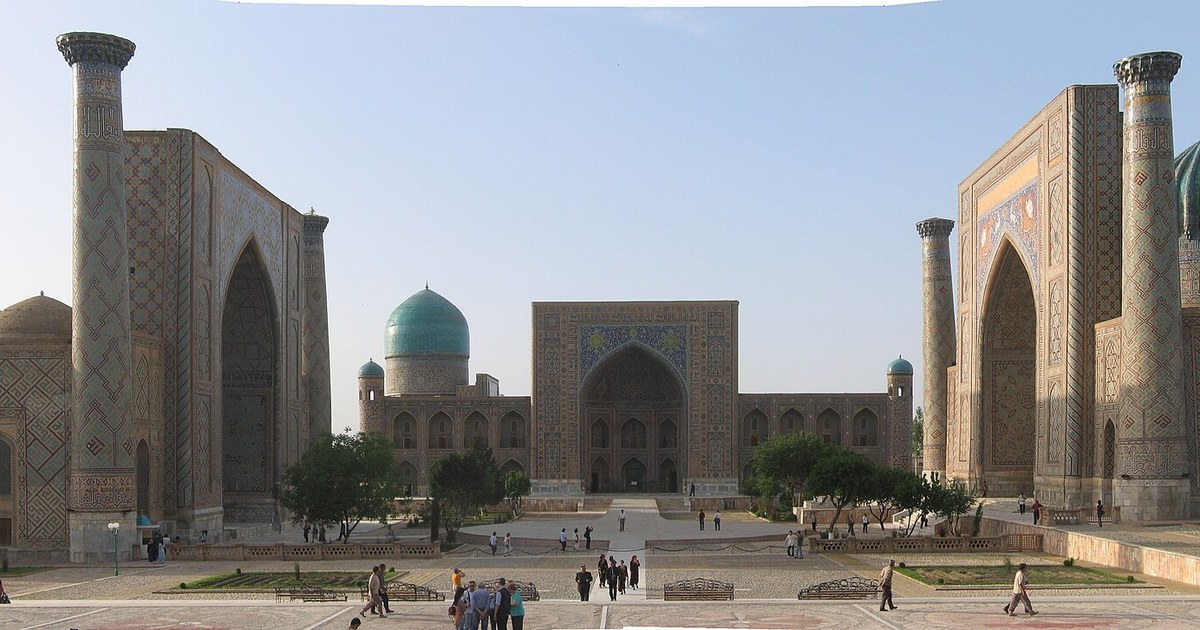
Samarkand is the name everyone knows, and it earns it. The Registan, three madrasas facing each other across a vast square, is the single most famous view in Central Asia: the Ulugh Beg Madrasa from 1420, Sher-Dor with its famous tiger mosaics, and Tilya-Kori, gilded inside. Go early for the square nearly empty, and again at dusk when the tilework turns gold.
Beyond the square, the Shah-i-Zinda necropolis climbs a hill in a corridor of turquoise tombs, the Bibi-Khanym Mosque still staggers visitors with its scale, and the Siab Bazaar sells bread, dried fruit and spices under a modern dome. Timur himself rests in the Gur Emir Mausoleum, which has its own full guide on this site. Give Samarkand two full days at minimum; three if you add Shakhrisabz below.
2. Bukhara: the old town that still lives
Where Samarkand performs, Bukhara simply exists, and many travellers end up loving it more. The historic centre is a lived-in maze of madrasas, caravanserais and trading domes around the Lyab-i Hauz pool, where old men play chess under mulberry trees. The Kalon Minaret, standing since 1127 and nearly 47 metres tall, so impressed Genghis Khan that he spared it. The Ark, the emirs’ fortress, broods over the western edge of town, and Chor Minor hides down a side street with its four little towers.
Bukhara rewards slowness: stay inside the old town, drink tea in a chaikhana, and let the city work at walking pace. Two days is right.
3. Khiva: the walled museum-city
Khiva’s Itchan Kala is a complete walled city of clay-coloured palaces, mosques and minarets, preserved so perfectly it can feel like a film set until the call to prayer and the smell of bread remind you people live here. Climb the Islam Khoja minaret, at 57 metres the tallest in the country, and note the Kalta Minor beside it: a fat, turquoise minaret that was meant to dwarf everything and was never finished. The Juma Mosque hides a forest of more than 200 carved wooden columns, some a thousand years old.
Khiva is the far end of the route, reachable by flight to Urgench (about 90 minutes from Tashkent) or by the high-speed trains covered in our Uzbekistan trains guide. One full day covers it; two lets you see it at dawn, which is when it is best.
4. Tashkent: more than a gateway
Most visitors land in Tashkent and leave the same day, which undersells it. The capital mixes eras like nowhere else in the country: the Hazrati Imam complex guards a Quran said to be among the oldest in the world, Chorsu Bazaar trades under a vast blue dome, and the 1977 metro, the first in Central Asia, doubles as an underground gallery of themed stations (photography has been allowed since 2018). Soviet avenues, Timur statues and a growing food scene fill the gaps. One to two days, ideally at the start of the trip while you adjust.
5. Shakhrisabz: Timur’s hometown
Ninety kilometres south of Samarkand, over a mountain pass, Shakhrisabz is where Timur was born, and he built accordingly: the surviving portal of his Ak-Saray palace still towers over the town. The Dorut Tilovat complex and the Kok Gumbaz mosque complete an easy half-day trip that pairs naturally with Samarkand.
6. Fergana Valley: silk, ceramics and the real Uzbekistan
East of the Kamchik pass, about five hours from Tashkent by train or road, the Fergana Valley is greener, warmer and more traditional than the desert cities, and almost no tour groups reach it. In Margilan, the Yodgorlik factory weaves silk ikat by hand the old way. Rishtan has made blue ceramics for centuries. Kokand keeps the Khudayar Khan palace, all painted ceilings and tile. Two days here shows you the Uzbekistan Uzbeks live in, and it changes the trip.
7. Nurata and Lake Aidarkul: a night in a yurt
On the edge of the Kyzylkum desert, Nurata holds a hilltop fortress attributed to Alexander the Great and the Chashma spring, sacred and full of fish. An hour beyond it, yurt camps on the shore of Lake Aidarkul offer the classic desert night: camel rides at sunset, swimming in the lake, akyn singing by the fire and a sky full of stars. One night, placed between Bukhara and Samarkand, breaks the city rhythm perfectly.
8. Nukus and Moynaq: art and the Aral Sea
Nukus, capital of the Karakalpakstan republic in the far west, would be a transit town if not for the Savitsky Museum: Igor Savitsky quietly collected tens of thousands of works of Soviet avant-garde art that Moscow had banned, and the museum now holds one of the largest such collections anywhere. It alone justifies the flight.
From Nukus, Moynaq is a long day trip of about 200 kilometres each way. It was a fishing port on the Aral Sea, once the world’s fourth-largest lake, until Soviet irrigation diverted its rivers for cotton and the water retreated over a hundred kilometres. The fleet now rests on sand, rusting under a memorial, beside a small museum that tells the story plainly. It is the most sobering place in the country, and one of the most important to see.
9. Termez: Buddhism on the Afghan border
Termez, in the deep south on the Amu Darya river opposite Afghanistan, breaks every expectation of Uzbekistan. Before Islam, this was a centre of Buddhism on the Silk Road: the Fayaz Tepe monastery and the Zurmala stupa date to the first centuries AD. Islamic monuments followed, including the Sultan Saodat complex. Few foreigners come, flights from Tashkent take about an hour, and the border-city atmosphere, with the Friendship Bridge in view, is unlike anywhere else on this list.
10. Chimgan Mountains: the capital’s escape hatch
When Tashkent heats up, locals head 80 kilometres east into the Chimgan range in the Ugam-Chatkal National Park. The Amirsoy resort, opened in 2019, runs gondolas for skiers in winter and hikers in summer, and Beldersay adds quieter trails. It makes an easy day trip or a cool overnight at the end of a desert-heavy route.
Putting it together: the classic route
The route almost everyone takes runs west in a line, and the trains make it simple. For the money side of the same trip, see our Uzbekistan travel budget guide.
- 7 days: Tashkent (1) → Samarkand (2) → Bukhara (2) → Khiva (2, including the travel day). The essentials, nothing wasted.
- 10 days: add Shakhrisabz as a day trip from Samarkand and one yurt night at Lake Aidarkul between Bukhara and Samarkand.
- 14 days: add the Fergana Valley (2) and choose one of Nukus and Moynaq (2, with flights) or Termez (2).
Spring (April and May) and autumn (September and October) are the sweet spots: warm days, cold nights, everything open. Summer brings 40 degree heat to the desert cities, and winter is cold and grey but nearly empty. The best time question gets a full guide of its own on this site soon.
Places to visit in Uzbekistan: frequently asked questions
What is Uzbekistan known for? The Silk Road cities above all: Samarkand’s Registan, Bukhara and Khiva, all UNESCO-listed. After that, plov (the national dish), ikat silk, ceramics, and a reputation for hospitality that visitors consistently say is real.
Is Uzbekistan worth visiting? Yes, if you care about history, architecture or Central Asia at all. Nowhere else packs this much Silk Road heritage into such an easy, affordable route. If your travel style needs nightlife and beaches, it is the wrong country, and it is better to know that before booking.
How many days do you need in Uzbekistan? Seven days covers the classic loop of Tashkent, Samarkand, Bukhara and Khiva without rushing. Ten to fourteen lets you add the Fergana Valley, a yurt night, or the Aral Sea, which is where the trip gets distinctive.
What is the number one place to visit in Uzbekistan? The Registan in Samarkand. It is the image on every brochure for a reason, and unlike many icons, it is bigger and bluer in person than in photographs.