
Hot Springs / New York
New York Hot Springs: The One Warm Spring
One dataset record leads the whole state: the lukewarm spring at Lebanon Springs in Columbia County, with source temperature, history, and planning tips.
New York holds one mapped thermal spring. The dataset lists a single record: Lebanon Spring in New Lebanon, in Columbia County near the Massachusetts line. Its source temperature is 72 degrees. That makes it a lukewarm spring, not a hot soak, and the only documented thermal spring in the state. The spring itself is not open to the public today. It sits behind posted signs on private land. This guide maps the one record. It tells the spring’s long story, from Mohican gathering place to Shaker neighbor to faded resort. It explains why the state has only one spring, and where the real soaking happens instead: the cold mineral springs of Saratoga. A source temperature is not a pool temperature. A mapped record is not automatically a resort.
We may earn a commission if you book through the links on this page, at no extra cost to you. That commission helps keep this guide free.
How to use this guide
Start with the table below for the one mapped spring. Then open the interactive US hot springs map to see the record by location. A spring page with directions, access notes, and photos will link from this hub when it publishes. The area in the table is a broad region, not a driving distance. Lebanon Spring holds no public soaking, and Saratoga’s mineral springs are cold water for tasting, not hot soaking. Base your expectations on the source temperature, not on the word hot spring.
The counts behind this guide need one honest note. The dataset holds one New York record. It carries lukewarm status, and it is soakable in the dataset sense, which means the water itself is warm enough to enter, not that entry is allowed. No New York source reaches 98 degrees. No site in this guide is a true hot soak by the dataset figures. The pool and spring figures in this guide come from published guides, and they are labeled as published figures. Every number here is a source temperature unless the text says otherwise.
The one New York thermal spring
This one record is the whole mapped set for the state. There is no second spring to compare it with, and no hidden spring waiting in the data. The temperature is a source temperature from USGS data. The area is a broad region from the dataset, not a driving distance.
| Spring | Source temp | Area |
|---|---|---|
| Lebanon Spring | 72°F | New Lebanon, Columbia County |
Lebanon Spring: the spring, the history, the place
What the water is
The spring is real thermal water, and it is not hot. The dataset records the Lebanon Spring source at 72 degrees. Published guides put the spring at a steady 73 degrees, and an 1849 geological survey recorded a uniform 70 degrees. The three figures describe the same water measured in different places and at different times. This guide keeps them separate. 72 degrees is the dataset source figure. About 73 degrees is the published figure at the spring. Either way, the water is lukewarm. It is a warm spring, not a hot spring, by any temperature scale a soaker would use.
The water rises from deep in the Taconic rocks. An 1849 survey of New York mineral waters called the New Lebanon springs truly thermal, because their mean temperature runs higher than the place where they issue. The same survey noted that nitrogen gas constantly escapes from the surface, and that lime is the principal solid element, present only in small quantities. The water tastes a little sweet, according to a recent account, and it runs clear. The spring emerges just north of New Lebanon village, near Route 22, on the western slope of the Taconic Mountains. It is the same family of water as Sand Spring across the line in Williamstown, Massachusetts, about 20 miles east in a straight line.
The Mohican gift
Long before Europeans arrived, Mohicans gathered at the springs. Their village of Kaunaumeek lay nearby, and they had visited the springs for many centuries, believing in the water’s curative powers for skin conditions. In 1756, they are said to have sold their rights to the springs on the condition that the waters remain open to all people in perpetuity. The land changed hands again in 1759, when the Mohicans sold the village land to Charles Goodrich with the assurance that the healing waters would remain free. Goodrich kept the promise. In 1778, when he sold the property holding the springs, he restated the Mohican wishes and gifted the springs to the Town of New Lebanon, with language meant to insure that all people would have free use of the waters for all times.
The promise has been tested. Three court cases over ownership of the springs reached the New York Supreme Court, and in all three the court ruled in favor of free public use of the waters. The Mohican Blessing Fountain stands as the public marker of that history. The New Lebanon Garden Club erected it in 1941 to give thanks to the Mohican people for their gift of the healing waters to all people forever. The fountain was connected to the original source in the 1930s. It once stood in the middle of Route 22, and it was moved to a nearby park in the 1980s, where visitors can still see it today. The fountain is the closest the public can now come to the spring itself.
The Shaker years
Just south of the springs, another community was drawn to the same valley. In the 1780s, Mother Ann Lee and her followers, known as Shakers for their practice of ecstatic dancing, established a religious community devoted to celibacy, simplicity, and equality between the sexes. The village known as Mount Lebanon grew into the largest and most influential Shaker settlement in the country. At its height, the Mount Lebanon society owned about 6,000 acres, reaching into Massachusetts and the town of Canaan. The Shakers built their seed business and their herb trade here, and their fields became models of neatness and skill.
The Shaker community dwindled through the 20th century. Only a handful of Shakers still practice the faith today. The Shaker Museum at Mount Lebanon preserves many of their structures, and the village stands as the historic neighbor of the springs. The two stories belong together. The springs drew the Mohicans, then the resort builders, and the Shakers built their largest village in the same valley, within sight of the same warm water.
The resort rise and fall
By the early 1800s, Lebanon Springs had become famous. It was a popular destination for leisure travelers and for people seeking relief from various ailments. A chemical analysis of the waters was published in 1818 by Dr. William Meade, who treated the spring as a bath and a medicine. Hotels rose around the water. Columbia Hall, the grand hotel of the resort era, anchored the village. The spring was the reason the village existed, and the village grew around the spring.
The Civil War marked the beginning of the end for Lebanon Springs as a resort community. The springs lost out in a rivalry with Saratoga, about fifty miles to the northwest and easier to reach from the seaboard cities. Saratoga had the railroad, the grand hotels, and the crowds. Lebanon Springs had the warmer water and the quieter valley, and the quieter valley lost. Columbia Hall was demolished about a century ago. The resort era ended, and the village went back to being a small town on the road to Boston.
The spring today
Today, the springs are hidden behind posted signs. The source sits on private land, and there is no public access to the water. Do not trespass. The dataset calls the spring soakable because the water is warm enough to enter, not because entry is allowed. No pool operates at the spring, no admission is sold, and no hours are posted. The public way to meet the spring is the Mohican Blessing Fountain in its park near Route 22, and the Shaker Museum at Mount Lebanon nearby. Both are open to visitors. The spring itself is a story now, not a soak.
That story is worth the visit anyway. New Lebanon sits in the Taconic valley, between the Berkshires and the Hudson, and the village holds the whole arc of American spring history in a few square miles: a Native gift, a Shaker village, a resort rise, a resort fall, and a fountain that still runs. Come for the history, and for the valley, not for a swim.
Why New York has only one thermal spring
New York has one thermal spring because the Northeast has almost nowhere to make one. A hot spring needs heat close to the surface, and that heat usually comes from recent volcanism or from young, thin crust. New York has neither. Its rocks are old, its crust is thick and cold, and its last volcanoes died hundreds of millions of years ago. The ground here does not run hot. It runs cold, and it stays cold.
Lebanon Spring is the exception, and its own story explains why. The water does not come from hot rock near the surface. It comes from depth: the 1849 survey traced the New Lebanon springs to faults and fractures in the Taconic rocks, where water rises from great depths and keeps the earth’s ordinary warmth. That is why the spring is warm rather than hot, and why it is alone. The geology that makes one lukewarm spring in New Lebanon cannot make a second one somewhere else in the state. The same Taconic system makes the single lukewarm spring across the line in Williamstown, Massachusetts. Every other mapped spring in the Northeast sits the same way, as a lone lukewarm record in a cold state.
The same geology explains the shape of this guide. A state with one lukewarm spring, closed to the public, cannot support a list of resorts, and this guide does not pretend otherwise. What New York offers instead is a single honest story, and a separate mineral springs tradition that runs cold. The history, the Shaker village, and Saratoga do the work that a dozen hot springs would do in the West.
Saratoga Springs: the mineral springs that are not hot springs
The 21 springs
Saratoga Springs is the famous spring town of New York, and its springs are not hot springs. The city holds 21 public mineral springs, more than any other city in America, and the water in them is cold. It is carbonated water, rich in minerals and salts, rising from fissures in the Saratoga Fault, which runs about 65 miles from Whitehall to Albany. Each spring has a different mineral mix and a famously distinct taste. Hathorn is often called the most palatable. Geyser is the most sulfurous. Visitors walk a free self-guided tour with a cup in hand and taste them one by one. Bring your own cup or water bottle. The springs are for drinking, not for soaking.
Congress Spring, discovered in 1792, became the centerpiece of Congress Park and the village that grew around it. Its water was bottled and sold around the world, and it was the most famous of the Saratoga mineral waters. High Rock Spring started it all, and it still draws visitors to the park. The springs made Saratoga, and they still define it. The town grew up around the water, and the water still runs.
The park and the baths
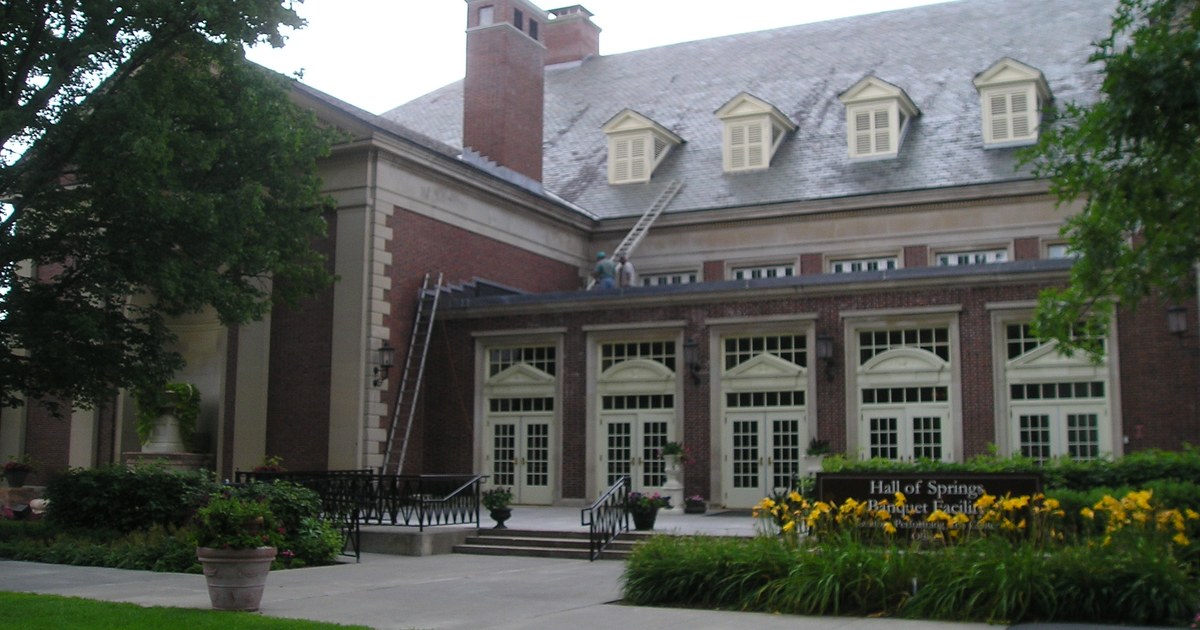
Saratoga Spa State Park covers 2,379 acres on the south side of the city. It is a National Historic Landmark, and its grounds hold mineral springs, classical bath and spa houses, and the Saratoga Performing Arts Center. The Hall of Springs, the marble pavilion in the park, anchors the spring grounds. The Roosevelt Baths and Spa, built in 1935, still offers mineral bath soaks in the original building, inside the Gideon Putnam hotel. The water in the baths is mineral water, heated for the bath, not hot spring water. That distinction matters, and this guide states it plainly.
Two of the most visited springs in the park sit along Geyser Creek. The Geyser Island Spouter sends a narrow plume of water 10 to 15 feet into the air, and it first emerged in the early 1900s. Orenda Spring has built a massive tufa dome, a mound of hardened minerals that keeps growing as the spring overflows and fossilizes leaves and debris. A half-mile trail along the creek links the spouters and the tufa springs. The park runs free guided tours of the springs on weekend mornings. Pick up the free self-guided mineral springs map at the visitor center near the Hall of Springs.
What the water is
Saratoga water is cold, carbonated, and mineral rich. The springs are not thermal, and none of them appears in the USGS thermal dataset. The carbonation comes from the fault, and the minerals come from the rock the water passes through. The water tastes of salt, iron, and sulfur in different measures at different springs. Some visitors love it. Some find it undrinkable. Either way, it is the real mineral water tradition of New York, and it is free to taste. Go to Saratoga to take the waters, not to take a hot soak.
The other old spa towns: Sharon Springs and Richfield Springs
Sharon Springs
Sharon Springs, a village in Schoharie County, was the other great spa town of 19th century New York. Its mineral waters are sulfur waters, cold, not thermal. Four different mineral waters flow in the village: sulfur, magnesia, chalybeate, and Blue Stone springs. The Gardner Spring carried so much sulfur gas that the waters of its creek ran white as milk and coated the stones with a thick deposit. The village grew into a bustling spa. At the peak of its popularity, it hosted about 10,000 visitors each summer, including members of the Vanderbilt family. Oscar Wilde lectured at the Pavilion Hotel in 1882. Several large hotels were built between 1836 and 1860. Today the hotels stand abandoned, and the village is listed as a historic spa village on the National Register of Historic Places.
The Iroquois frequented the healing waters long before the hotels, and the village was settled around 1780. Come for the historic district and the sulfur springs, not for hot water. The water here runs cold.
Richfield Springs
Richfield Springs, in Otsego County, grew around its own sulfur springs. The Iroquois knew the springs as Ganowauges, the stinking waters, and used them as a curative for frostbite and other ailments. Europeans are believed to have found the springs in 1754. Dr. Horace Manley bought the site of the Great White Sulphur Spring in 1820 and promoted the waters, and the village dates its birth as a watering place to his work. By 1830, Richfield Springs had become the center of an extensive trade in its mineral waters, and by mid-century it held large hotels with hundreds of guests. The village incorporated in 1861.
A stone fountain at the Great White Sulphur Spring, erected in 1931, still stands beside the roadway, and a historical marker tells the resort story. The springs are sulfur springs, cold, not thermal, and none of them appears in the USGS thermal dataset. Come for the marker and the village, not for a hot soak.
The nearest springs beyond New York
The nearest mapped spring outside New York sits about 20 miles east, in a straight line. Sand Spring in Williamstown, Massachusetts, records 75 degrees at the source, and it carries lukewarm status like Lebanon Spring. It is the only documented thermal spring in New England, and it feeds Sand Springs Pool, a community pool that has run on the site since the 1820s. The two springs are the pair that the Northeast thermal map actually holds. One lukewarm spring sits in New York. One sits across the state line in Massachusetts. Nothing else follows for hundreds of miles.
After Sand Spring, the map goes quiet. The next nearest mapped springs are more than 310 miles away, in West Virginia. Swan Pond Spring sits at about 314 miles. Berkeley Springs sits at about 321 miles. Both record 72 degrees. Those distances are straight-line figures, not driving distances. They say plainly what the Northeast thermal map looks like. Two lukewarm springs sit in the Taconic valley. Then comes a long empty stretch before the next warm water. A traveler chasing hot springs does not drive south from New Lebanon. They drive west, toward the Rockies, or they accept the mineral springs they have.
Springs that are not what they seem
Heated pools are not hot springs
New York has plenty of heated pools, spa tubs, and hotel soaking tubs. None of them is a thermal spring. A heated pool is warm because a heater warms it. A thermal spring is warm because the earth warms it. The distinction matters to a traveler who searches for hot springs and finds a hotel spa instead. The Roosevelt Baths in Saratoga heat mineral water for the bath. That is a spa treatment, not a hot spring. Lebanon Spring is the one place in the state where the warmth comes from the ground. Everywhere else, the warmth comes from a boiler.
New York City has no thermal spring
New York City has no thermal spring in the dataset. Searches for hot springs near New York City lead to Saratoga, to Lebanon Spring, or to heated hotel pools, and none of those is a hot soak near the city. Saratoga sits about three hours north of the city. Lebanon Spring sits east of Albany, near the Massachusetts line. Neither is a day trip from Manhattan for a soak, and Lebanon Spring is closed to the public in any case. Plan the trip around Saratoga’s mineral springs and the Hudson Valley, not around a hot spring that does not exist near the city.
Planning a New York hot springs trip
Base in Saratoga Springs or Albany
Base in Saratoga Springs for the mineral springs, or in Albany for the Hudson Valley and the Taconic valley. Saratoga holds the 21 public springs, the state park, the Hall of Springs, and the Roosevelt Baths. Albany sits west of New Lebanon, and it is the natural base for the Lebanon Spring story, the Shaker Museum at Mount Lebanon, and the Mohican Blessing Fountain. Stay in Saratoga for the springs you can taste, and drive to New Lebanon for the spring you can only read about. The two towns make a single trip: cold mineral water in the morning, warm spring history in the afternoon.
Seasons and safety
The season decides the trip. Saratoga’s mineral springs run year round, and the park is open in every season. The guided spring tours run on weekend mornings. Winter in upstate New York is cold, and the warm spring water at Lebanon Spring would feel warmest when the air turns cool, but the spring is closed to the public in every season. Do not trespass on posted land at Lebanon Spring. Respect the signs, respect the neighbors, and respect the gift the Mohicans made: the waters were given for all people, and the way to honor that gift today is to visit the public fountain and the museum, not to climb a fence. Check current hours for the park, the baths, and the museum before you travel, because hours move with the season.
Safety follows the same rule as everywhere else on this site. Saratoga’s mineral waters are for tasting, not for drinking in quantity. The sulfur springs taste strong, and the mineral load varies from spring to spring. Taste a little, and bring plain water for the rest of the walk. At Lebanon Spring, the safety rule is simpler: stay on public ground. The spring is private land, and the posted signs are the rule.
New York hot spring temperature guide
Lukewarm sources
Source temperatures in this guide are grouped the way visitors actually feel them. Lukewarm sources under 98 degrees are pleasant on a warm day but will not feel like a hot soak. They make up the whole New York set: one record, Lebanon Spring at 72 degrees. The published figure at the spring is about 73 degrees, and the 1849 survey recorded a uniform 70 degrees. The source temperature is not a pool temperature, and there is no pool at Lebanon Spring in any case.
The classic soaking range
The classic soaking range runs from the high 90s to about 110 degrees. No New York source reaches it by the dataset figures. Lebanon Spring at 72 degrees sits well below the range, and that gap matters for expectations. Do not come to New Lebanon for a hot soak. Come for the history, and go to Saratoga for the mineral water. The Roosevelt Baths heat their mineral water for the bath, and that is the closest thing to a warm soak in the state’s spring tradition.
Hot sources and unknown temperatures
No New York site records a source above 100 degrees. The hottest mapped source in the state is Lebanon Spring at 72 degrees. No New York site carries an unknown dataset temperature. Every record in the set carries the temperature the dataset gives it, and this guide claims no temperature it cannot source.
Etiquette and Leave No Trace
Hot springs etiquette is simple. It matters most at a place like Lebanon Spring, where the spring is private and the public history is the point. Visit quietly, and leave the grounds as you found them. Pack out everything you bring in.
The spring sits on ground that was a Mohican gathering place for centuries before it was a resort. The waters were given for all people, and three court cases upheld that gift. The gift lives on in the public fountain and in the museum, not in a trespass. Do not climb fences, do not ignore posted signs, and do not disturb the spring. At Saratoga, taste the springs with your own cup, and leave the springheads as you found them. A clean, quiet visit is what keeps the one thermal spring in New York, and the mineral springs around it, open to everyone.
Frequently asked questions
Is there a hot spring in New York?
Yes, one mapped thermal spring: Lebanon Spring in New Lebanon, Columbia County, with a source temperature of 72 degrees. It is a lukewarm spring, not a hot soak, and it is the only documented thermal spring in the state.
Can you soak at Lebanon Spring?
No. The spring sits on private land behind posted signs, with no public access, no pool, and no admission. The public way to meet the spring is the Mohican Blessing Fountain in its park near Route 22, and the Shaker Museum at Mount Lebanon nearby.
How hot is the water at Lebanon Spring?
The dataset records the Lebanon Spring source at 72 degrees, and published guides put the spring at about 73 degrees year round. An 1849 survey recorded a uniform 70 degrees. The source temperature is not a pool temperature, and there is no pool at the spring.
Are the Saratoga Springs hot springs?
No. Saratoga’s 21 public mineral springs are cold, carbonated mineral water for tasting, not thermal water. The Roosevelt Baths heat mineral water for the bath. Go to Saratoga to take the waters, not to take a hot soak.
Where is the nearest hot spring outside New York?
Sand Spring in Williamstown, Massachusetts, about 20 miles east of Lebanon Spring in a straight line. Its source temperature is 75 degrees. After that, the next mapped springs are more than 310 miles away in West Virginia.
Source temperatures are measured at the spring source; pools and developed areas usually run cooler. Always check current conditions before visiting.