
Hot Springs / South Dakota
South Dakota Hot Springs: Evans Plunge
Five mapped springs, one Black Hills town, and an 1890 mineral pool at 87 degrees, with source temperatures, history, and planning tips.
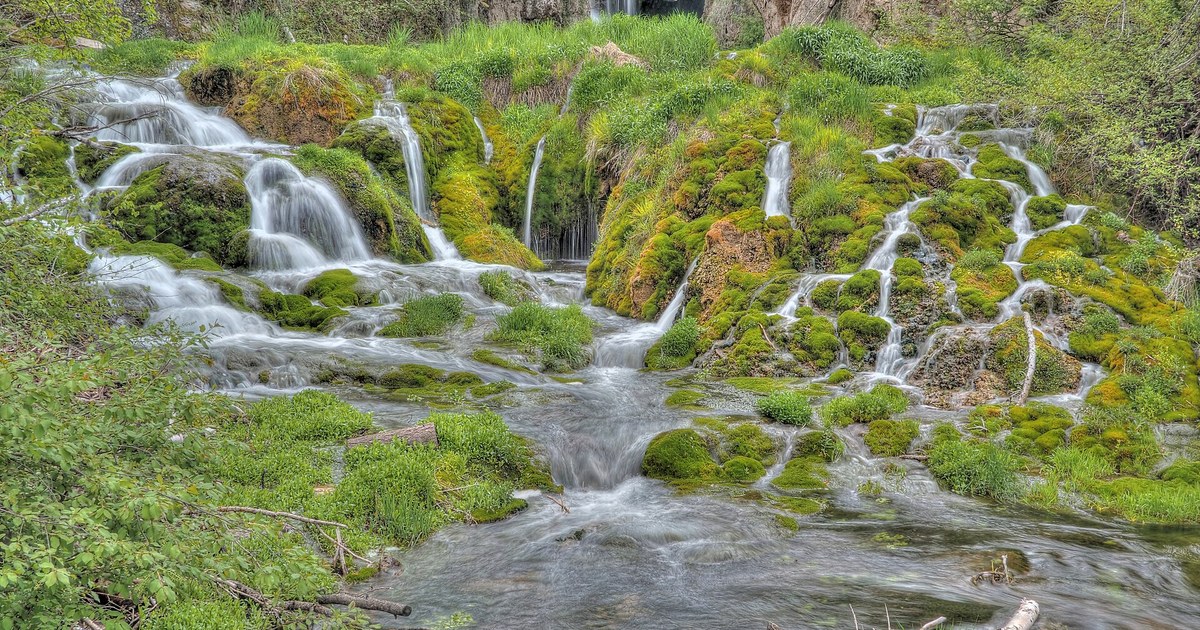
South Dakota holds five mapped thermal springs, and all five sit in or beside one town. The town is Hot Springs, in Fall River County at the southern edge of the Black Hills. The dataset lists two lukewarm records with source temperatures and three entries with no dataset temperature. The warmest dataset source runs 87 degrees. The town built its identity on that water. Its two soaking places, Evans Plunge and Moccasin Springs, stand a few blocks apart in the sandstone downtown.
This guide maps all five records. It tells the Evans Plunge story, from an 1890 pool built over the springs to the oldest attraction in the Black Hills. It covers the adults-only spa at Moccasin Springs and the free swim hole at Cascade Falls. It explains why the state holds so few warm springs, and where the nearest warm water sits beyond the state line. A source temperature is not a pool temperature. A mapped record is not automatically a resort.
We may earn a commission if you book through the links on this page, at no extra cost to you. That commission helps keep this guide free.
How to use this guide
Start with the table below for the five mapped springs. Then open the interactive US hot springs map to see the records by location. A spring page with directions, access notes, and photos will link from this hub when it publishes. The area in the table is a broad region, not a driving distance. Two of the five are paid facilities, one is a free Forest Service swim hole, and two are dataset records with no developed soak. Book ahead at the paid places, and check hours before you drive out.
The counts behind this guide need one honest note. The dataset holds five South Dakota records. Two carry lukewarm status, at 87 and 75 degrees. Three carry no dataset temperature. Published figures fill those three gaps, and this guide labels them as published wherever they appear. Every number here is a source temperature unless the text says otherwise.
The five South Dakota thermal springs
These five records are the whole mapped set for the state. There is no sixth spring hiding in the data. The temperatures are dataset source temperatures. The three rows with no dataset temperature are explained in the sections below, with published figures labeled as published. The area is a broad region from the dataset, not a driving distance.
| Spring | Source temp | Area |
|---|---|---|
| Hot Springs | 87°F | Hot Springs, Fall River County |
| Hot Brook Springs | 75°F | Hot Springs, Fall River County |
| Moccasin Springs Natural Mineral Spa | No dataset temp | Hot Springs, Fall River County |
| Evans Plunge | No dataset temp | Hot Springs, Fall River County |
| Cascade Falls | No dataset temp | Cascade Creek, Fall River County |
Evans Plunge: the spring, the history, the pool
What the water is
The springs that feed Evans Plunge run 87 degrees year round, by the facility’s own published figure. The dataset’s Hot Springs record for the town spring system gives the same 87 degrees at the source. Thirteen springs feed the pool, and the facility says water arrives at 5,000 gallons a minute. The water is mineral rich and low in sulfur, so it smells clean rather than eggy. The Lakota called the springs Minnekahta. The pool is warm, not hot. At 87 degrees it feels like a warm bath, not a hot soak. The facility itself is clear about that, and this guide keeps the same line.
The 1890 pool and the resort town
Fred Evans built the pool in 1890 over the natural spring. It is the oldest attraction in the Black Hills. The town grew around the same water in the 1880s, when Hot Springs was marketed as a health resort. It was platted in 1879. Its sandstone downtown still looks much as it did before 1930, and the historic district is listed on the National Register of Historic Places. Native peoples used the warm mineral water long before the resort era. The Cheyenne camped around the springs in the mid-1800s, and the Sioux held them after 1869. The overflow from the springs forms the Fall River, which runs southeast out of town toward the Cheyenne River.
The pool today
Today Evans Plunge is owned and operated by the City of Hot Springs. It holds an indoor pool and an outdoor pool, plus a health club included with admission. It is open year round. The address is 1145 N River Street. Hours vary by season, so confirm current hours before visiting. The pool suits families and casual swimmers. It is a public pool fed by warm mineral water, not a quiet spa. Go for the history and the warm water, not for a hot soak.
Moccasin Springs: the adults-only spa in the old bathhouse
Six pools in the 1890 bathhouse grounds
Moccasin Springs is the quieter of the two soaks, and the hotter one. It is an adults-only spa, 18 and over. Six outdoor natural mineral pools sit in the grounds of an 1890 bathhouse. Published guides put the pool temperatures from the high 80s to just over 100 degrees. The Moccasin Pool itself runs about 93 degrees, with a natural red rock floor. The 1913 Pool was built in 1913. The water is untreated mineral water, rich in silica and calcium by published accounts. The site also holds a sauna, a yoga studio, and a restaurant, plus cabins, bungalows, and tent camping. The address is 1829 Minnekahta Avenue. The on-site lodging was reported closed for renovations in late 2025, with no reopening date announced at the time of writing in early 2026. Check current hours before visiting.
Who it suits
The spa suits a quiet adult soak, not a family swim day. Children are not admitted. Voices stay low, and the pools are for resting, not for play. Book ahead. The pools are small, and a quiet spa fills fast. A weekday visit is quieter than a summer weekend. Come for the warm mineral water and the old bathhouse grounds, and plan on staying an hour or two rather than a whole day.
Cascade Falls: the free swim hole
Cascade Falls is the free option, and the cool one. It is a spring-fed waterfall and swimming hole on Cascade Creek in Black Hills National Forest, roughly six to eight miles south of Hot Springs on South Dakota Highway 71. The creek is fed by Cascade Springs. The Forest Service lists the springs at about 22.5 cubic feet per second, at a near-constant 67 degrees. The water stays that temperature year round, so the falls keep flowing through winter.
A stairway leads down a steep bank to the falls. Swimming is permitted at the falls, not up at Cascade Springs itself. The swim hole is the pool at the base, closest to the parking lot. The water is cool and clear, and it gets deep fast. There are no bathrooms or changing areas. Watch for poison ivy and rattlesnakes. Check current Forest Service notices before visiting, since trail and water conditions can change.
Hot Brook Springs and the town springs
The dataset holds two more Hot Springs records beyond the two facilities and Cascade Falls. The first is listed simply as Hot Springs, at 87 degrees at the source. It is the dataset record for the town spring system, not a separate place to soak. Its water is the same 87-degree water that feeds Evans Plunge. The second is Hot Brook Springs, at 75 degrees at the source, on Hot Brook north of the downtown. Hot Brook is the creek that runs through town.
Neither record marks a developed soak. They mark the water itself. Together they show what the town is built on: a cluster of warm springs in one small valley, all within a short walk of each other. The town’s whole resort story starts with these records. Evans Plunge and Moccasin Springs are the two places where that water is open to visitors.
Why South Dakota has so few thermal springs
South Dakota has five mapped thermal springs because almost the whole state is cold ground. A hot spring needs heat close to the surface. That heat usually comes from recent volcanism or young, thin crust. South Dakota has neither, except in the Black Hills. The Hills are an old uplift, and warm water rises there through faults and fractures from depth. It keeps the earth’s ordinary warmth on the way up. That is why the water runs warm rather than scalding, and why it sits in one town. The rest of the state is plains over cold rock.
The same pattern holds across the region. Wyoming holds the big hot water to the west. South Dakota holds one warm valley in its southwest corner. The guide does not pretend otherwise. What the state offers is a single honest story, and a small town built around it. The history, the sandstone streets, and the Black Hills around them do the work that a dozen hot springs would do in the West.
The nearest springs beyond South Dakota
The nearest mapped spring outside South Dakota sits about 105 miles away, in a straight line. Warm Springs, called Immigrants Washtub, in Wyoming records 70 degrees at the source, and it carries lukewarm status. Douglas Hot Springs in Wyoming sits about 111 miles away, at 86 degrees. After that, the map goes quiet for a long stretch.
Alcova Hot Springs in Wyoming sits about 175 miles away, at 129 degrees. Horse Creek Springs in Wyoming sits about 190 miles away, at 75 degrees. Saratoga Hot Springs in Wyoming sits about 218 miles away, at 129 degrees. Those distances are straight-line figures, not driving distances. They say plainly what the map looks like. One warm valley sits in the southern Black Hills. Then comes a long empty stretch before the next warm water. A traveler chasing hot springs does not drive east from Hot Springs looking for a second soak. They drive west, toward Wyoming, or they accept the soaks the one town holds.
Springs that are not what they seem
87 degrees is warm, not hot
The first confusion is the temperature. Evans Plunge runs 87 degrees. That is a warm pool, not a hot soak. The facility’s own listing says it plainly, and visitor reviews repeat it. The water feels like a warm bath. It will not feel like the 100-degree tubs of a resort hot spring. Moccasin Springs is the exception, with pools published into the low 100s. Judge each place by its own temperature, not by the words hot spring.
Cascade Falls at 67 degrees is a cool swim hole
The second confusion is Cascade Falls. At 67 degrees it is a cool, clear swim hole, not a hot spring soak. It is a fine summer stop. It is not a place to warm up on a cold day. The creek water stays 67 degrees in every season, so the falls are as cool in January as they are in July.
Heated pools are not hot springs
Hot Springs and the Black Hills hold plenty of heated pools, hotel soaking tubs, and water parks. None of them is a thermal spring. A heated pool is warm because a heater warms it. A thermal spring is warm because the earth warms it. The distinction matters to a traveler who searches for hot springs and finds a hotel spa instead. Evans Plunge and Moccasin Springs are the two places in the state where the warmth comes from the ground.
The Mammoth Site is fossils, not water
The Mammoth Site sits in the town of Hot Springs, and it is the town’s other big draw. It is a fossil site, not a spring. Go for the mammoths. Do not go looking for a soak there.
Planning a South Dakota hot springs trip
Base in Hot Springs or Rapid City
Base in the town of Hot Springs itself for the soak, or in Rapid City for a longer Black Hills trip. Hot Springs holds both soaking places, the sandstone downtown, and the Mammoth Site, all within a short walk or drive. Wind Cave National Park sits north of town on US 385. Rapid City sits about 50 miles north, and it is the natural base for Mount Rushmore, Badlands National Park, and the northern Hills. Hot Springs works as a day trip from Rapid City. Stay in town for the springs you can walk to, and drive north for everything else.
Book ahead, and check hours
Book ahead at Moccasin Springs, and confirm hours at Evans Plunge before you drive out. Hours move with the season, and the spa’s lodging was reported closed for renovations in late 2025. The pools are small, and a quiet spa fills fast. A weekday visit is quieter than a summer weekend. Call ahead for current hours and availability.
Seasons and safety
The season decides the trip. The pools run year round. The best soak is often the coldest day, when the air runs well below freezing and the steam rises off 87-degree water. Summer brings warm days, and Cascade Falls is at its best then, as a cool swim hole. Winter in the Black Hills is cold, so bring layers for the walk back from the pool.
Safety follows the same rule as everywhere else on this site. Stay hydrated. Do not soak alone if you have a health condition that makes heat risky. Get out if you feel lightheaded. At Cascade Falls, watch the depth, the current, and the footing. The spring water is mineral water, not drinking water, and the pools are for soaking, not for drinking.
South Dakota hot spring temperature guide
The classic soaking range
Source temperatures in this guide are grouped the way visitors actually feel them. The classic soaking range runs from the high 90s to about 110 degrees. No South Dakota dataset source reaches it. The hottest dataset source in the state is 87 degrees. Moccasin Springs is the one place where published pool temperatures reach into the low 100s, and those are pool figures, not dataset source figures. The source temperature is not a pool temperature, and the pool figure is the one that decides how the soak feels.
Lukewarm sources and unknown temperatures
Two South Dakota records carry lukewarm status, at 87 and 75 degrees. Three carry no dataset temperature at all. This guide claims no temperature it cannot source. The published figures for those three, 87 degrees at Evans Plunge, 88 to 105 degrees at Moccasin Springs, and 67 degrees at Cascade Falls, are labeled as published figures wherever they appear. The hottest mapped source in the state is the Hot Springs record at 87 degrees.
Etiquette and Leave No Trace
Hot springs etiquette is simple. It matters most at a place like Hot Springs, where the springs are small and the town is smaller. Book your soak, show up on time, and leave the pool as you found it. At Moccasin Springs, keep voices low. It is an adults-only spa, and quiet is part of the place. At Cascade Falls, pack out everything you bring in, and stay out of the springs themselves. The falls are the swimming place. The springs above them are not.
The springs sit on ground that Native peoples used for centuries before it was a resort town. Visit quietly, spend locally, and leave the creek banks and the trails as you found them. Pack out everything you bring in. Do not wade into Hot Brook or Cascade Creek looking for a wild soak. There is no wild soak here, only the two facilities and the falls. A clean, quiet visit is what keeps the warm water in Hot Springs, and the small town around it, open to everyone.
Frequently asked questions
Are there hot springs in South Dakota?
Yes, five mapped thermal springs, all in or beside the town of Hot Springs in Fall River County. Two are soaking places, Evans Plunge and Moccasin Springs, one is the free swim hole at Cascade Falls, and two are dataset records with no developed soak.
How hot is Evans Plunge?
The springs that feed Evans Plunge run 87 degrees year round, by the facility’s published figure. The dataset’s Hot Springs record for the town spring system gives the same 87 degrees at the source. It is a warm pool, not a hot soak.
What is Moccasin Springs?
An adults-only natural mineral spa in Hot Springs, with six outdoor pools in the grounds of an 1890 bathhouse. Published guides put the pool temperatures from the high 80s to just over 100 degrees. It is 18 and over, and it charges admission.
Can you swim at Cascade Falls?
Yes, at the falls, in the pool at the base near the parking lot. The water runs about 67 degrees year round. Swimming is not allowed up at Cascade Springs itself. There are no bathrooms or changing areas, so plan ahead.
Where is the nearest hot spring outside South Dakota?
Warm Springs, called Immigrants Washtub, in Wyoming, about 105 miles away in a straight line, with a source temperature of 70 degrees. After that, Douglas Hot Springs in Wyoming sits about 111 miles away, at 86 degrees.
Source temperatures are measured at the spring source; pools and developed areas usually run cooler. Always check current conditions before visiting.