
Hot Springs / West Virginia
West Virginia Hot Springs: The First Spa
Six mapped springs, two historic spa towns, and the warm water George Washington bathed in, with source temperatures, history, and planning tips.
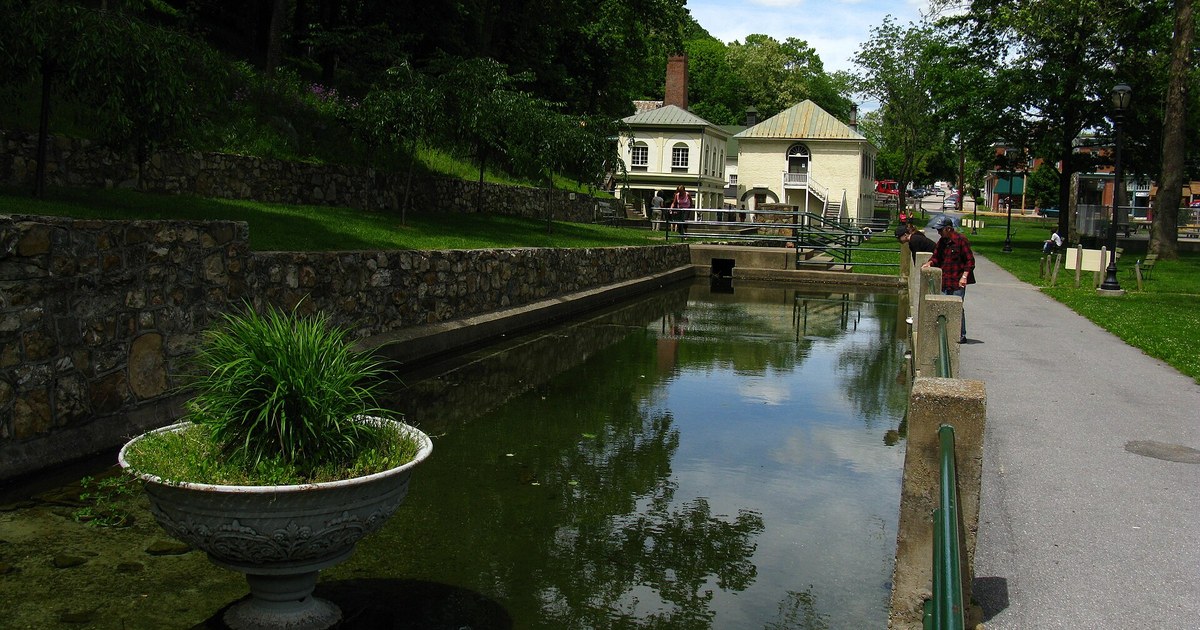
West Virginia holds six mapped thermal springs, and the whole story sits in two spa towns. The first is Berkeley Springs, in Morgan County, where warm mineral water has drawn visitors since before the United States existed. The second is White Sulphur Springs, in Greenbrier County, where the sulphur spring became The Greenbrier, the grand resort. The other four records are quieter. They are a lost resort in Monroe County, a bottled-water spring in Pocahontas County, and two undeveloped springs near Franklin and Shepherdstown.
This guide maps all six records. It tells the Berkeley Springs story, from a 16-year-old George Washington to the only state-run spa in the country. It covers The Greenbrier’s sulphur spring and the resort it built. It explains why no West Virginia source is a true hot soak. It also shows where the nearest real hot water sits across the state line in Virginia. A source temperature is not a pool temperature. A mapped record is not automatically a place to soak.
We may earn a commission if you book through the links on this page, at no extra cost to you. That commission helps keep this guide free.
How to use this guide
Start with the table below for the six mapped springs. Then open the interactive US hot springs map to see the records by location. A spring page with directions, access notes, and photos will link from this hub when it publishes. The area in the table is a broad region, not a driving distance. One of the six is a public soak, one is a resort spa, and one is closed for restoration. Three are quiet records with no developed soak. Book ahead at the two that take visitors, and check hours before you drive out.
The counts behind this guide need one honest note. The dataset holds six West Virginia records. Five carry lukewarm status, with dataset source temperatures from 70 to 73 degrees. One, The Greenbrier, carries no dataset temperature. Published figures fill some of those gaps, and this guide labels them as published wherever they appear. Every number here is a source temperature unless the text says otherwise.
The six West Virginia thermal springs
These six records are the whole mapped set for the state. There is no seventh spring hiding in the data. The temperatures are dataset source temperatures. The Greenbrier row carries no dataset temperature, and the section below explains what the resort’s spring is. The area is a broad region from the dataset, not a driving distance.
| Spring | Source temp | Area |
|---|---|---|
| Old Sweet Spring | 73°F | Sweet Springs, Monroe County |
| Thorn Spring | 72°F | Franklin, Pendleton County |
| Swan Pond Spring | 72°F | Shepherdstown, Jefferson County |
| Berkeley Springs | 72°F | Berkeley Springs, Morgan County |
| Minnehaha Springs | 70°F | Marlinton area, Pocahontas County |
| The Greenbrier (White Sulphur Springs) | No dataset temp | White Sulphur Springs, Greenbrier County |
Berkeley Springs: America’s first spa
What the water is
The springs at Berkeley Springs flow at a constant 74.3 degrees, by the state park’s own published figure. The dataset records 72 degrees for the same springs, and the park figure is the one the spa itself uses. Five major springs rise from the Oriskany sandstone of Warm Springs Ridge. They merge on the park grounds, producing about 2,000 gallons of clear mineral water a minute. The water carries sulfates, magnesium carbonates, and nitrates. It holds its temperature in every season because it circulates deep underground. It is warm water, not hot water. At 74 degrees it feels like a warm bath, and the park is clear about that.
Washington and the first spa
George Washington first visited the springs on March 18, 1748, at 16, as a member of a survey party mapping the western limits of Thomas Lord Fairfax’s lands. His diary entry for the day reads, in his spelling, that the party called to see the famed warm springs. He came back again and again as an adult. He bought town lots when they were sold in 1777. He did more than anyone to spread the springs’ fame through the colonies.
Three signers of the Declaration of Independence, four signers of the Constitution, seven members of the Continental Congress, and five Revolutionary War generals were among the first buyers. Fairfax himself had decreed the springs free for public use, and a park has surrounded them since the 1740s. The town calls itself America’s first spa, and the claim holds up. No other American spa town has a longer continuous bathing history.
The park today
Today Berkeley Springs State Park is the smallest state park in West Virginia. It is also the only state-operated spa in the United States. It sits in the center of town at 2 South Washington Street. The Roman Bath House was built in 1815. It is the oldest public building in town, and it still holds nine tiled chambers with 750-gallon tubs. The tubs are filled with spring water heated to 102 degrees, so the soak is warmer than the source. The main bathhouse opened in 1930 and holds the spa services, massages, saunas, and showers. The park also holds the recreated tub where Washington supposedly bathed, rebuilt in the 1930s. A spring on the grounds lets visitors fill jugs with the mineral water. Book the spa ahead, especially on weekends. The park is listed on the National Register of Historic Places.
The Greenbrier: the sulphur spring resort
The spring that started it
The Greenbrier began with a sulphur spring, not a hot one. In 1778 a pioneer woman named Mrs. Anderson bathed in the spring water and drank it to ease her chronic rheumatism. She followed the local Native American tradition of taking the waters. Within weeks her pain had eased, and word spread. Thomas Jefferson mentioned the spring in his Notes on the State of Virginia in 1784. For the first 125 years the place was known simply as White Sulphur Springs, for the water that drew people there. The dataset carries no temperature for the spring, and this guide claims none. It is a cool sulphur spring, and its story is the resort it built, not a hot soak.
The Old White
Cabins went up in 1811, cottages in 1820, and the President’s Cottage in 1834. By the 1830s the resort drew judges, lawyers, diplomats, planters, and merchants from across the South for the summer season.
The Grand Central Hotel opened in 1858. It was known as the White, and later the Old White. It held 228 rooms and a dining room that seated 1,200 guests, the largest in the country at the time. The first train reached White Sulphur Springs station on June 29, 1869, and the resort’s reach widened. The Chesapeake and Ohio Railroad bought the property in 1910. It built the new Greenbrier hotel, which opened on September 25, 1913. The resort went year round in 1914. The obsolete Old White was demolished in 1922. The resort stands today as a National Historic Landmark at 101 Main Street West in White Sulphur Springs.
The resort today
The Greenbrier’s mineral spa still uses the spring water, in a spa that serves resort guests. It is a resort spa, not a public soak, so plan a stay or check the resort before visiting. The white-columned spring house still stands at the center of the property. Its green dome is the symbol of the resort. Come for the history and the grand hotel, not for a public hot spring. The Greenbrier is the grandest chapter in West Virginia’s spring story, and it is the one chapter that asks for a reservation.
Old Sweet Springs: the lost resort
Old Sweet Springs, in Monroe County, was once the grandest spa in western Virginia after the Greenbrier, and today it is a restoration site. The spring was discovered in 1760, and William Lewis built the first hotel around 1792. The resort’s brick hotel went up in 1830, in a classical style that recalls Thomas Jefferson’s architecture. It was finished by 1833. The bathhouse followed in 1850. The 1859 season drew 2,752 guests. The water runs 73 degrees at the source, by both the dataset and published accounts. It carries iron and carbon dioxide. It is a chalybeate water with a brisk, carbonated taste, once called the best acidulous water in the United States.
The guest list reads like a history book. George and Martha Washington passed through. So did General Lafayette, Chief Justice John Marshall, Patrick Henry, James and Dolley Madison, and Robert E. Lee. A Virginia district court met on the grounds from 1795 to 1807, and a courthouse and jail were built there.
The resort struggled after the Civil War, went bankrupt in 1930, and the state bought the property in 1941. It served as a tuberculosis sanitarium from 1941 to 1945, then as the Andrew S. Rowan Memorial Home for the aged from 1945 to 1991. The buildings were listed on the National Register of Historic Places in 1970. Investor Ashby Berkley bought the property at auction in 2015. He set up the Sweet Springs Resort Park Foundation to restore it. Construction on an extension began in September 2024. The springs are not open for public soaking. Visit for the history, from the road, and do not expect a soak.
Minnehaha Springs: the bottled-water spring
Minnehaha Springs sits in Pocahontas County, where the waters of Douthard’s Creek empty into Knapp’s Creek, about nine miles east of Marlinton. The Lockridge family found the mineral springs on their farmland and tested the water in 1891 and again in 1910. They formed the Pocahontas Mineral Water Development Company and sold the water in bottles. A hotel went up on the hill above the spring in 1914, with a bathhouse and a pool at the foot of the hill. A bathing pool opened to the public in 1912. The hotel burned on February 4, 1945.
The spring was said to flow about a million and a half gallons a day. Published accounts put its temperature at 72 to 75 degrees, against a dataset figure of 70 degrees. The community took its name from Minnehaha, the maiden of Longfellow’s poem, after Indian relics were found near the springs. It is the only community with this name in the United States. The post office ran from 1912 to 1989. Today the site is Camp Twin Creeks, and warm mineral springs can still be found there, but it is a camp, not a public soak. Do not drive out expecting to bathe.
Thorn Spring and Swan Pond Spring: the quiet records
Two West Virginia records are quiet springs with no resort story at all. Thorn Spring sits near Franklin, in Pendleton County, in Thorn Spring Park, a non-profit owned property close to the road. Published spring registries put its temperature at 72 degrees, matching the dataset. Swan Pond Spring sits near Shepherdstown, in Jefferson County, at a low elevation of 460 feet. Published registries also put it at 72 degrees, matching the dataset. Neither record marks a developed soak, a bathhouse, or a pool. They mark the water itself, two more points on the same Appalachian warm-spring belt that runs through the state. This guide lists them because the dataset holds them. It claims nothing more for them than the records support. If you visit, go to look, not to soak.
Why West Virginia has so few thermal springs
West Virginia has six mapped thermal springs because the state sits on old, cold ground. A hot spring needs heat close to the surface, and that heat usually comes from recent volcanism or young, thin crust. West Virginia has neither. What it has is the Appalachian warm-spring belt. It is a line of springs that runs through Virginia and West Virginia. Water circulates deep through faults and fractures there, and it picks up the earth’s ordinary warmth on the way back up. The water emerges lukewarm, in the low 70s, because the circulation is deep but the heat is modest. That is why the state’s springs are warm mineral springs, not hot springs. It is also why the resort story here is about history and healing water rather than heat.
The same pattern holds across the border. Virginia holds the hotter water. Hot Springs runs 106 degrees, and Warm Springs runs 95 degrees, both a short drive from the West Virginia line. West Virginia holds the older spa towns. The two states tell one story together. Warm water sits in the west, hotter water in the east, and a resort tradition grew up around both. This guide does not pretend otherwise. What the state offers is a short, honest list, and two spa towns with more history than most hot spring states can claim.
The nearest springs beyond West Virginia
The nearest mapped spring outside West Virginia sits about a mile away, in a straight line. Sweet Chalybeate Spring in Virginia records 75 degrees at the source, and it carries lukewarm status. It sits just across the state line from Old Sweet Spring, in the same valley. The two springs are part of one story. After that, the map fills in fast. Warm Springs in Virginia sits about 13 miles from Minnehaha Springs, at 95 degrees. Jefferson Pools in Virginia sits about 13 miles away as well, with no dataset temperature, though the published source figure is 98 degrees. Hot Springs in Virginia sits about 14 miles away, at 106 degrees. It is the nearest true hot soak to any West Virginia spring.
Healing Springs in Virginia sits about 15 miles away, at 86 degrees. Bolar Spring in Virginia sits about 17 miles away, at 73 degrees. Layton Spring in Virginia sits about 18 miles away, at 72 degrees. Those distances are straight-line figures, not driving distances. They say plainly what the map looks like. West Virginia’s own water runs warm, in the low 70s. The hot water sits just across the line in Bath County, Virginia, a short drive from the Greenbrier Valley. A traveler chasing a hot soak does not stop at the state line. They drive through it, toward Warm Springs and Hot Springs, and they come back to Berkeley Springs for the history.
Springs that are not what they seem
72 to 74 degrees is warm, not hot
The first confusion is the temperature. No West Virginia dataset source reaches 98 degrees, and none is a true hot soak. Berkeley Springs runs 74.3 degrees at the source, by the park’s published figure. That is a warm mineral bath, not a hot spring soak. The Roman Bath House tubs run 102 degrees because the spring water is heated for the tubs. The heat comes from a heater, not from the ground. Judge each place by its own temperature, not by the words hot spring.
The Greenbrier is a resort spa, not a public soak
The second confusion is The Greenbrier. The sulphur spring sits at the center of a grand resort, and the mineral spa serves resort guests. It is not a public bath, and it is not a place to walk in off the road. Plan a stay, or check the resort before visiting. The spring house is a landmark to see, and the spa is a service for guests.
Old Sweet Springs is closed, and Minnehaha is a camp
The third confusion is the two historic resorts. Old Sweet Springs is under restoration, and its springs are not open for public soaking. Minnehaha Springs is now Camp Twin Creeks, and its warm springs sit on camp ground. Both places reward a drive past and a look at the history. Neither one is a soak.
Thorn Spring and Swan Pond Spring are records, not destinations
The fourth confusion is the two quiet records. Thorn Spring and Swan Pond Spring are dataset entries with published temperatures of 72 degrees, and no developed soak stands at either one. They are worth knowing about, and they are not worth a special trip. The dataset lists them, and this guide lists them, because the map is the map. A record is not a resort.
Planning a West Virginia hot springs trip
Base in Berkeley Springs or White Sulphur Springs
Base in Berkeley Springs for the soak, or in White Sulphur Springs for the resort. Berkeley Springs holds the state’s one public soak, the small state park, and a walkable arts town, all within a few blocks. White Sulphur Springs holds The Greenbrier and the Greenbrier Valley, with the Virginia hot springs a short drive east. The two towns sit about three hours apart by road. Pick one as a base, and treat the other as a separate trip, or as a stop on a longer loop through the Alleghenies. The Virginia springs at Warm Springs and Hot Springs sit close to White Sulphur Springs, and they make a natural second day.
Book ahead, and check hours
Book ahead at the Berkeley Springs State Park spa, and confirm hours before you drive out. The spa’s tubs and treatments fill fast on weekends. At The Greenbrier, book a stay or check the resort before planning a spa visit. The mineral spa serves resort guests. Hours move with the season at both places. A weekday visit is quieter than a summer weekend at the park, and the resort is quieter outside its peak season.
Seasons and safety
The season decides the trip. The springs run year round. The best soak is often the coldest day, when the air runs well below freezing and the steam rises off the warm water. Summer brings warm days, and the park’s spring grounds are at their best then, as a place to walk and sit by the water. Winter in the Alleghenies is cold, so bring layers for the walk back from the bathhouse.
Safety follows the same rule as everywhere else on this site. Stay hydrated. Do not soak alone if you have a health condition that makes heat risky. Get out if you feel lightheaded. The spring water is mineral water, not drinking water. The one exception is the park spring where visitors may fill jugs. The pools are for soaking, not for drinking.
West Virginia hot spring temperature guide
The classic soaking range
Source temperatures in this guide are grouped the way visitors actually feel them. The classic soaking range runs from the high 90s to about 110 degrees. No West Virginia dataset source reaches it. The hottest dataset source in the state is Old Sweet Spring, at 73 degrees. Berkeley Springs runs 74.3 degrees at the source, by the park’s published figure, and its bathhouse tubs are heated to 102 degrees. The source temperature is not a pool temperature, and the pool figure is the one that decides how the soak feels.
Lukewarm sources and unknown temperatures
Five West Virginia records carry lukewarm status, at 70 to 73 degrees. One, The Greenbrier, carries no dataset temperature at all. This guide claims no temperature it cannot source. The published figures for the lukewarm records are labeled as published wherever they appear. They are 74.3 degrees at Berkeley Springs, 73 degrees at Old Sweet Springs, 72 to 75 degrees at Minnehaha Springs, and 72 degrees at Thorn Spring and Swan Pond Spring. The hottest mapped source in the state is the Old Sweet Spring record at 73 degrees.
Etiquette and Leave No Trace
Hot springs etiquette is simple. It matters most at a place like Berkeley Springs. The springs are small, and the park sits in the middle of a town. Book your soak, show up on time, and leave the bathhouse as you found it. At the park, keep voices low in the bathhouse, and respect the quiet of the spring grounds. At the resort springs, follow the resort’s rules, and remember that you are a guest in a grand hotel, not at a public pool.
The springs sit on ground that Native peoples used for centuries before it was a resort town. The resort towns grew up around water that was already famous. Visit quietly, spend locally, and leave the spring grounds and the trails as you found them. Pack out everything you bring in. Do not wade into a spring looking for a wild soak. There is no wild soak here, only the state park spa and the resort. A clean, quiet visit is what keeps the warm water in Berkeley Springs, and the small towns around it, open to everyone.
Frequently asked questions
Are there hot springs in West Virginia?
Yes, six mapped thermal springs. None is a true hot soak: five are lukewarm, at 70 to 73 degrees, and one, The Greenbrier, carries no dataset temperature. Berkeley Springs is the state’s one public soak, at 74.3 degrees by the park’s published figure.
How hot is Berkeley Springs?
The springs flow at a constant 74.3 degrees, by the state park’s published figure. The dataset records 72 degrees for the same springs. The Roman Bath House tubs are filled with spring water heated to 102 degrees, so the soak is warmer than the source.
Can you visit the Greenbrier springs?
The sulphur spring sits at the center of The Greenbrier resort in White Sulphur Springs, and the mineral spa serves resort guests. It is not a public soak, so plan a stay or check the resort before visiting.
Can you soak at Old Sweet Springs?
No. The historic resort in Monroe County is closed and under restoration by the Sweet Springs Resort Park Foundation, and its springs are not open for public soaking. Visit for the history, from the road, and do not expect a soak.
Where is the nearest real hot spring outside West Virginia?
Hot Springs, Virginia, at 106 degrees, about 14 miles from Minnehaha Springs in a straight line. Warm Springs, Virginia, at 95 degrees, sits about 13 miles away. Both are a short drive east from the Greenbrier Valley.
Source temperatures are measured at the spring source; pools and developed areas usually run cooler. Always check current conditions before visiting.