Mono Lake California is a strange, beautiful saline lake in the eastern Sierra, near the town of Lee Vining, and it is one of the most unusual places in the state. The lake is twice as salty as the ocean, and its shore is lined with tufa towers, pale stone formations that rise from the water like a ruined city. The lake has no fish, but it feeds millions of birds, and its water story is one of the most important environmental fights in California. This guide covers Mono Lake California, from the tufa towers and the birds to the water story, visiting, and where to stay.
The tufa towers
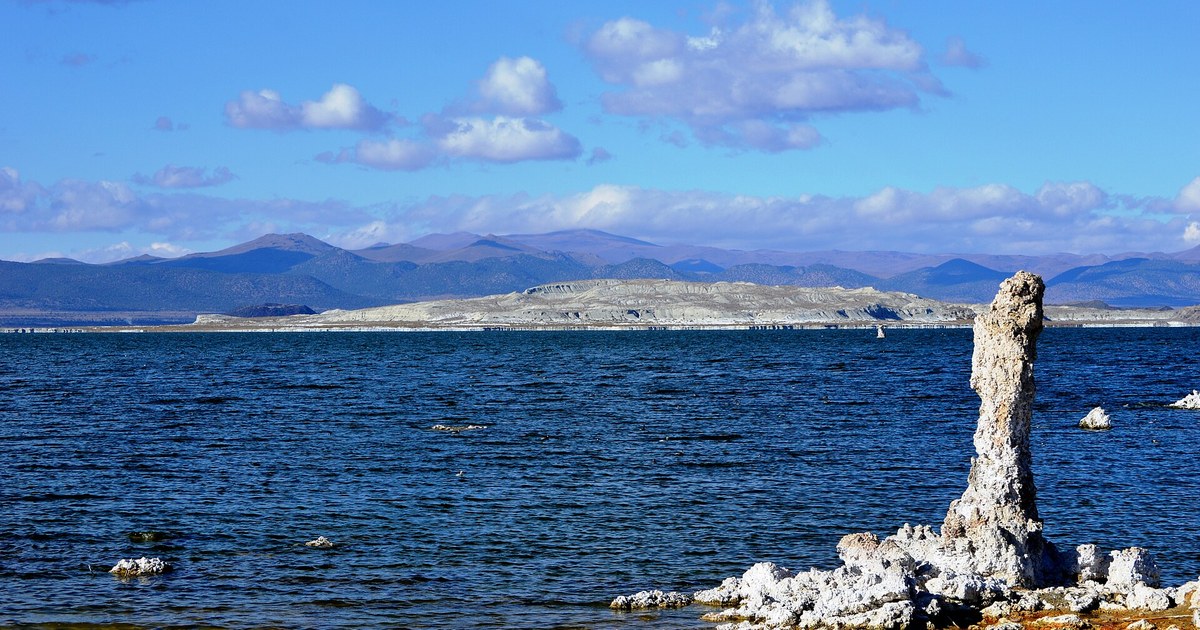
The tufa towers are the lake’s signature. Tufa is calcium carbonate, and it forms underwater when calcium-rich spring water meets the lake’s carbonate-rich water. The mineral builds up into towers, and when the lake level falls, the towers are exposed on the shore. The most famous grove is South Tufa, on the southern shore, where a trail winds among the towers and down to the water. The towers are pale, knobby, and strange, and they look different in every light, from white in the midday sun to gold at sunset.
South Tufa is the main place to see the towers, and it has a short, flat trail that is easy to walk. The trail leads through the tufa grove to the lakeshore, and it is the best place to photograph the towers, especially at sunrise and sunset, when the light is low and the towers cast long shadows. The towers are fragile, so visitors should stay on the trail and not climb on them. The lake’s other tufa groves are harder to reach, and South Tufa is the one most visitors see.
The lake’s water story
Mono Lake’s water story is a famous California environmental case. Starting in 1941, the city of Los Angeles diverted the lake’s tributary streams to supply water to the city, and the lake level fell by about 45 feet. The falling water exposed the tufa towers, raised the salinity, and threatened the birds and the shrimp that depend on the lake. In the 1970s and 1980s, the Mono Lake Committee and others fought to protect the lake, and in 1994, the State Water Resources Control Board ordered the lake level to be restored.
The lake is still recovering, and the water level rises and falls with the snowpack and the diversions. The tufa towers that are now visible are a result of the lower lake level, and they are a reminder of the lake’s history. The Mono Lake Committee, a nonprofit, runs a visitor center and bookstore in Lee Vining, and it continues to work for the lake’s protection. The lake is a place where visitors can see both a strange landscape and a real conservation story.
Birds and wildlife
No fish live in Mono Lake, because the water is too salty and too alkaline, but the lake is full of life. Brine shrimp and alkali flies thrive in the water, and they feed millions of migratory birds. California gulls nest on the lake’s islands, and phalaropes and eared grebes stop at the lake on their migrations. The lake is one of the most important bird habitats in the western United States, and it is a major stop on the Pacific Flyway.
The best time for birds is spring and fall, when the migrations are at their peak and the lake is full of birds. The gulls nest in summer, and the phalaropes gather in huge numbers in late summer and fall. The lake’s islands are closed to visitors during the nesting season, to protect the birds. Bring binoculars and a field guide, and visit the Mono Basin Scenic Area Visitor Center in Lee Vining for information on what is at the lake now.
Photography at Mono Lake
Mono Lake is one of the best places in California for photography. The tufa towers, the still water, and the wide sky make strong images, and the light is best at sunrise and sunset, when the towers turn gold and the water reflects the sky. The lake is a good place for long exposures, since the water is often calm, and for wide-angle shots that show the towers against the Sierra.
The best viewpoints are at South Tufa, where the trail gives access to the towers and the shore. Bring a tripod for sunrise and sunset, and a wide lens for the landscape. The lake’s light changes fast, so plan to stay for an hour or more, and visit in the morning or evening rather than the middle of the day.
Visiting Mono Lake
The main visitor area is South Tufa, on the southern shore, reached by a dirt road off Highway 120. There is a small parking fee, and the trail is short and flat, with signs explaining the tufa and the lake. The Mono Basin Scenic Area Visitor Center, in Lee Vining, has exhibits, maps, and ranger programs, and it is the best place to start a visit. The lake is a stop on the way to Yosemite’s Tioga Pass, and many visitors see it as part of an eastern Sierra trip.
The lake is not a swimming lake for most visitors. The water is very salty and alkaline, and it can irritate the eyes and skin, though some visitors do wade or float in it. Most people come for the tufa, the birds, and the landscape, not to swim. The best times to visit are spring and fall, when the weather is mild and the birds are present, and sunrise and sunset, when the light on the tufa is at its best. The visitor center offers ranger programs in summer, including walks at South Tufa and talks on the lake’s birds and water story, and it is worth checking the schedule when you arrive.
Where to stay near Mono Lake
Disclosure: this guide contains affiliate links. If you book through them, we may earn a commission at no extra cost to you.
The nearest town is Lee Vining, at the junction of Highway 395 and Highway 120, with motels, a few restaurants, and the Mono Lake Committee visitor center. Mammoth Lakes, to the south, has more hotels, restaurants, and services, and it is a good base for the eastern Sierra, including Mono Lake, the Mammoth area, and the road to Yosemite. Both towns are small and book up in summer, when Tioga Pass is open and visitors are most numerous, so book ahead. Search hotels in Mammoth Lakes on Booking.com
Getting there
Mono Lake is in Mono County, in the eastern Sierra, on Highway 395, near Lee Vining. The lake is about a five-hour drive from San Francisco and about a six-hour drive from Los Angeles, depending on the route. The nearest major road is Highway 395, which runs north-south along the eastern Sierra, and Highway 120 connects the lake to Yosemite’s Tioga Pass in summer. The lake is a good stop on an eastern Sierra road trip, and it pairs well with Yosemite, Mammoth Lakes, and the ghost town of Bodie. For a wider California trip, see our guide to California trip planning, and for a Yosemite guide, see our guide to El Capitan in Yosemite.